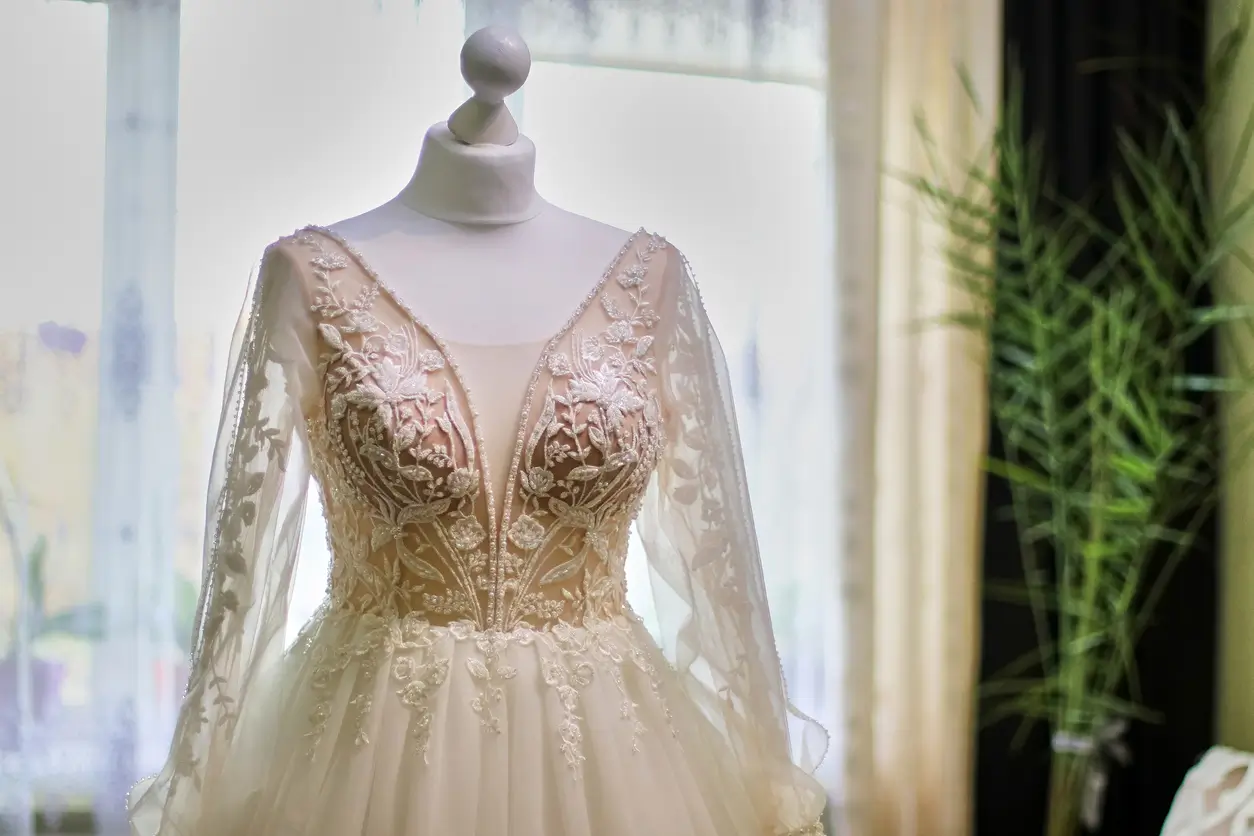
You spent months choosing this dress. Hours on alterations. Significant money on every detail. The preservation decision takes about fifteen minutes, usually while still in the post-wedding fog.
That gap is where most mistakes happen. This checklist slows down that decision to the speed it deserves.
Ask directly: Where is my dress actually being cleaned and packaged? Not where you drop it off, where the real work happens.
Many preservation services are middlemen. Your dress gets boxed and shipped to a facility hundreds of miles away, one you'll never see and can't call directly. Every leg of that trip adds risk: rough handling, temperature swings, and no local accountability if something goes wrong.
A provider who cleans and packages on-site, offering genuine professional wedding dress preservation rather than acting as a drop-off point, can answer your questions on the spot. One who has to check with a shipping partner can't.
A vague “we take great care of your dress” isn't a verification. Push further:
A confident, specific answer to these questions is a strong sign you're dealing with a real provider, not a drop-off point for someone else's facility.
The box and tissue matter almost as much as the cleaning. Standard cardboard and tissue contain acids that break down over time and migrate into your dress, causing the exact yellowing preservation is supposed to prevent.
Archival-quality materials are acid-free, lignin-free, and pH-buffered, stable enough not to react with silk, lace, or beading over decades. Using the best materials isn't an answer. Ask the provider to confirm the specifics in writing, or check if their website names the standards they use.
Every dress picks up different stains: champagne, makeup, grass, sweat. Each reacts differently to solvents, so each needs a different treatment.
A real preservation service inspects your dress, identifies each stain, and treats it accordingly. A boxing operation runs every dress through the same cycle regardless of what's on it, so some stains just don't come out.
Ask directly: Do you treat stains individually, or run one standard process for every dress? The answer tells you the kind of service you're dealing with.
Stain treatment isn't one-size-fits-all even within the same stain type:
If a provider can explain this kind of distinction without hesitation, that's a good sign they actually do individualized work.
Some boxes are sealed shut behind a viewing window and marketed as premium for it. In practice, a sealed box traps leftover moisture with nowhere to escape, and that can lead to mildew you won't discover until it's too late to fix.
An accessible box lets you or a professional check on the dress periodically, without breaking any seal.
Ask directly: Is this box sealed, or can it be opened and reclosed? Choose accessible storage whenever it's offered.
An accessible box only helps if you use it. As a general guideline:
Silk, satin, tulle, lace, and synthetic blends don't clean the same way. A solvent gentle on polyester can be too harsh for silk, and a method safe for plain satin can damage hand-sewn beading or lace appliqué. A provider using one standard method on every dress is likely getting uneven results.
Ask directly: What method will you use on my dress, and is it specific to this fabric? You want an answer built around your dress, not a generic response.
Certain details on a dress require extra caution no matter the base fabric:
Once a dress is folded into its box, it's out of sight for years. A stain that wasn't fully treated doesn't just stay put. It oxidizes slowly and can turn a faint mark into a visible spot by the time you open the box again. That's why a final check matters.
Ask directly: Can I see the dress before it's packaged for final approval? A provider confident in their work will show you what was treated, not seal it up without your input.
Make the most of this step rather than treating it as a formality:
Even a flawless preservation job can be ruined by where you store it afterwards. This is the step most brides skip, because by the time the box comes home, they assume the hard part is over.
The wrong storage spot works against everything the preservation service just did:
The right spot is a stable interior location, ideally an interior closet on a main floor, kept between 65 and 75°F with humidity below 50%.
If you're unsure whether your planned spot is safe, check for these signs first:
When you get your dress back, you'll be able to tell fairly quickly whether the job was done correctly. Wedding dress preservation performed properly should look like this: an acid-free archival box, acid-free tissue, and the bodice and skirt supported so nothing's crushed or sharply folded. The box opens for inspection instead of staying sealed shut, and you should get a documented summary of the stains that were found and how each was treated.
The dress itself should look true to its original color and smell neutral, not chemical, not musty. If any of that's missing, it's worth asking about before you call the job finished.
If you went through this checklist and still have questions about your own dress, that's exactly the right instinct. A dress this meaningful deserves answers before you commit, not after.
At LaFrance Cleaners, we've handled wedding dress preservation in the Mahoning Valley since 1945, and every step happens in-house: detailed inspection, professional cleaning matched to your fabric, careful pressing, and acid-free packaging into a preservation chest built for long-term storage.
For anyone searching for Wedding Dress Cleaning and Preservation Service, we'll walk you through each part of the process before your dress ever leaves your hands.
Call us today, and we'll answer every question on this checklist.
Phone: +1 330-403-8907
Email: office@lafrancecleaners.com
Locations: Boardman, Youngstown